

On 6 April 2025, the government raised the thresholds that determine whether a company is classed as micro, small, medium, or large.
This change - introduced by The Companies (Accounts and Reports) (Amendment and Transitional Provision) Regulations 2024 - means many UK businesses could benefit from simpler reporting requirements.
For companies that have grown steadily in recent years, this update could make a noticeable difference. Businesses previously pushed into higher reporting categories may now move back into a lower one, reducing disclosure requirements and making accounts preparation more straightforward. In practice, that means less time spent on compliance and more time focused on growing your business.
Why the change?
Company size thresholds determine the level of detail required in financial statements. Larger companies must provide more disclosures, while smaller ones can take advantage of reduced reporting requirements.
However, these thresholds hadn’t been updated for many years. Inflation and steady economic growth meant that many companies were being pushed into higher categories — not because they had fundamentally changed, but because the limits hadn’t kept pace.
The government’s goal is to bring the rules back in line with today’s business environment and to reduce unnecessary compliance.
The new thresholds at a glance
For accounting periods starting on or after 6 April 2025, the thresholds have increased by around 50%. A company qualifies for a size category if it meets at least two out of three criteria: turnover, balance sheet total, and number of employees.
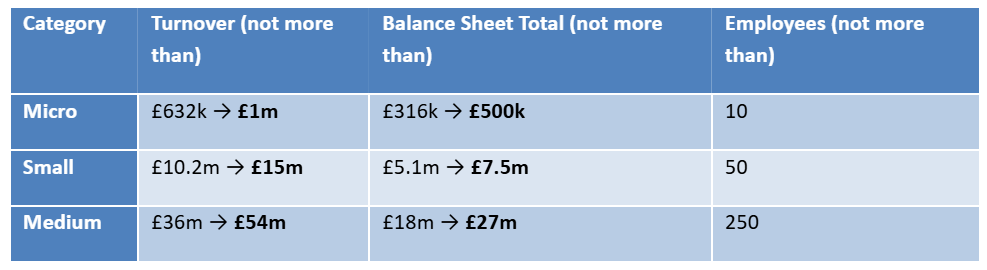
Anything above these limits will be classed as large.
A practical example
One of our clients - a Midlands-based engineering firm with a turnover of around £12m and 45 employees - currently qualifies as a medium-sized company. That classification means additional disclosures and stricter reporting.
Since April 2025, the same business falls into the small company category. This allows them to prepare accounts under the small companies’ regime, avoid producing a Strategic Report, and benefit from a lighter compliance load overall.
Changes to Directors' Report Requirements
To further reduce the regulatory burden, several detailed reporting requirements for medium and large companies have been removed. Since April 2025, the Directors’ Report no longer needs to include information about:
- The use of financial instruments
- Future business developments
- Research and development activities
- The existence of foreign branches
- Employment, training, and advancement of disabled persons
These updates are designed to streamline non-financial reporting, allowing businesses to focus more on growth while maintaining transparency where it matters most.
Why this matters
These changes offer simpler compliance and potential cost savings for many businesses. Smaller companies will benefit from reduced disclosure requirements and, in some cases, lighter filing obligations.
There may also be audit implications. While the audit exemption rules themselves aren’t changing, more businesses are likely to qualify as “small,” and therefore may no longer need a statutory audit.
For some companies, these new thresholds open up planning opportunities - particularly if you’re close to a boundary and want to assess how this could affect group structures, growth planning, or reporting strategy.
Finally, transitional rules mean that businesses can choose to apply the new thresholds immediately, without waiting for the usual two years of meeting the criteria.
How We Can Help
These updates are more than just administrative changes — they could make a real difference to your business’s reporting process. Our team can:
- Review your current size classification and forecast where you’ll sit under the new thresholds
- Advise whether you can benefit from simplified reporting requirements
- Guide you through the transitional options to adopt the new thresholds early
- Ensure your financial reporting continues to provide clarity for stakeholders
The new company size thresholds are a positive step for many UK businesses. They reduce unnecessary admin, ease compliance pressure, and let management focus more on running the company.
The impact varies depending on your specific circumstances, so it's best to review your position. If you’d like tailored advice on how these changes have affected your business, our team would be happy to help. Contact us today!
Author, Negin Balajam - Outsourced Finance
Negin.Balajam@ArnoldHill.co.uk